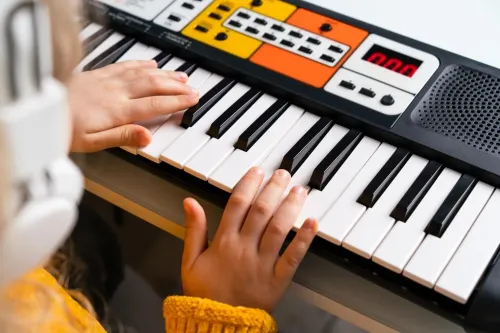
A long gap does not automatically put you back at beginner level, but it does make your current skills uneven. A short assessment, a manageable first-month routine, and lessons built around music you want to play can help you recover technique without wasting time or abandoning the habit again.
Key takeaways
- Test familiar songs and core skills before repeating beginner exercises.
- Use 7-day, 14-day and 30-day practice targets to rebuild consistency.
- Choose lessons around your goal, such as songs, accompaniment or music theory.
- Track minutes, repertoire and problem areas instead of judging one missed day.
Start with an honest skills check, not a page-one restart
Do not assume a long gap erased everything: begin with a 20-minute re-entry check, then separate familiar skills from those that need rebuilding. Before keyboard practice after a break, test the tasks you actually use rather than replaying old exercises from memory.
- Read eight to ten notes in your former range, then play a one-octave scale slowly. Mark where you hesitate, miss notes, or lose fingering.
- Play four common chords and change between them with a steady count of 1-2-3-4. A pause between changes shows chord knowledge that needs refreshing.
- Clap and play a simple rhythm with a metronome at a comfortable tempo. Notice whether you speed up during difficult bars.
- Play a short melody with both hands, then attempt one complete familiar song without stopping. Excessive finger lifting, shoulder tension, constant downward staring, and uneven transitions are rebuilding priorities.
- Record one minute of playing and give the recording to a teacher. Ask for one correction, a slower version of the task, and a second check that you can reproduce the change.
Use the results to choose a modest first-month target: steady pulse through one simple piece, five clean chord changes, or accurate reading across a defined note range. Practise for 10–20 minutes on four or five days each week, distributing sessions instead of cramming one long weekend block.
Familiar skills will return faster when the routine remains repeatable.
Use a 7-day, 14-day and 30-day plan to rebuild the habit
Treat keyboard practice after a break as a habit rebuild, not a test. Set a ten-minute minimum for busy days and a 25-minute optional session when time allows. Keep the keyboard ready, headphones connected, and practise at a fixed cue, such as after morning coffee or before dinner.
- Days 1–7: Practise five days for 10–15 minutes. Warm up with five-finger patterns, one familiar scale, and slow chord changes. End by playing a short, easy passage without stopping.
- Days 8–14: Practise five or six days for 15–20 minutes. Add a metronome, repeat difficult two-bar phrases, and combine the left-hand chords with the right-hand melody. Do not increase speed until the pulse stays even.
- Days 15–30: Aim for 20–30 minutes on four or five days each week. Work towards one measurable target: playing a simple piece with a steady pulse, changing between four named chords, or reading notes across a defined range.
Record the date, minutes, exercise, tempo, and troublesome passage in a short log. After one missed day, resume with the minimum session; do not compensate with an exhausting weekend practice. A class time that avoids Bengaluru traffic can protect this routine, while online lessons require a permanently positioned keyboard and clear audio.
Judge the format by weekly continuity, not lesson length.
Choose lessons that match a hobby player’s actual goal
A good choice is keyboard classes for adults that begin with your intended use, not a fixed page-one sequence. Tell the teacher whether you want to play songs casually, accompany singing, use pop chord patterns, read notation, improvise, or prepare for an examination; each goal changes the lesson priorities.
| Option | Main priority | What you receive |
|---|---|---|
| Beginner-only | Building every basic skill in sequence | Slow note reading, finger exercises, simple songs, and foundational technique; useful if you cannot yet locate notes or coordinate both hands |
| Examination-focused | Completing a graded syllabus accurately | Set repertoire, scales, sight-reading, and exam technique; less time for personal songs or informal accompaniment |
| Performance-focused | Preparing a polished public performance | Rehearsal, memorisation, expression, and playing without stops; pressure rises as the event approaches |
| Hobby-focused | Making regular playing enjoyable and usable | Familiar melodies, chord symbols or lead sheets, targeted reading, rhythm work, and repertoire chosen around your interests |
A returning hobby player might remember chord shapes or melodies while struggling with notation and rhythm. A teacher can separate those skills instead of labelling the whole learner a beginner: read a short passage slowly, practise rhythm away from the keys, and use chord-based accompaniment when that matches the goal.
Ask these questions before enrolling:
- Can lessons include songs I actually want to play?
- Will the teacher adjust assignments for a busy week?
- Does the programme leave room for improvisation or singing accompaniment?
- How will progress be checked if examination certificates are not my aim?
Choose a performance course only when a deadline motivates you, and choose an exam course only when its syllabus matters to you.
Make the class format support weekly continuity
Choose based on weekly continuity, not lesson length. A 60-minute class that requires a long Bengaluru commute can leave you with fewer practice days, while an online lesson fails if your keyboard, camera and audio setup are unreliable.
| Format | What it lets you do well | What can disrupt continuity | Best fit |
|---|---|---|---|
| Online | Save travel time and keep a short weekly check-in | Poor camera angle, compressed sound, keyboard latency or unstable internet can hide timing and hand-position problems | You have a reliable setup and a fixed quiet slot |
| In-person | Receive direct correction on posture, hand position, pedal use and timing | Travel, traffic and missed appointments can break the weekly rhythm | You need physical correction or struggle to diagnose technique alone |
Before you restart keyboard lessons in Bengaluru, ask for a fixed weekly time, a re-entry assessment and an assignment sized to your available practice days. Test the online setup by having the teacher hear direct keyboard sound, not only room noise.
Sri Veena Vani Music School becomes easier to evaluate when you ask whether its chosen format includes those continuity checks rather than selecting on convenience alone. Set one first-month target: play a simple piece with a steady pulse, change between four named chords without stopping, or read a defined range of notes.
Record the date, minutes, tempo and difficult passage after each practice session.
Related product
Keyboard Classes ₹3000 Sri Veena Vani Music School in Bengaluru, India, offers professional and structured keyboard classes for learners of all ages. View product → |
Measure progress so one missed practice day does not end the restart
A missed Tuesday should cost you one session, not your restart. Set a minimum practice commitment, such as 10 minutes or one exercise, for busy days; treat a longer session as optional. Distributed short sessions build more reliable recall than one intense weekend practice.
Use the practice log and lesson plan to make each stage measurable:
- Days 1–7: complete the minimum session on most days, review familiar notes and chords, and record the passage that breaks down.
- Days 8–14: add short rhythm or hand-coordination work and repeat the same piece until you can play a section with a steady pulse.
- Days 15–30: work towards one defined result, such as playing a simple piece without stopping or changing between four selected chords.
Record the date, minutes practised, exercise, tempo, and difficult passage. A teacher can use that evidence to reduce an assignment after a busy week or increase it when practice becomes comfortable, instead of giving the same workload every time.
For keyboard classes in Bengaluru for hobby learners, agree on a fixed lesson time and a weekly check-in. Review practice completed, not just attendance. If travel repeatedly removes practice time, reconsider the class format; online lessons fail when your keyboard position or audio is unreliable.
Progress should mean a small, visible gain, not instantly recovering your old level.
Frequently asked questions
How should I restart keyboard practice after a long break?
Start with a 20-minute re-entry check using familiar scales, chords, rhythms and a song you once played. Separate retained skills from areas that need rebuilding instead of restarting every exercise from page one.
What practice plan works after returning to keyboard lessons?
Set a 7-day goal for showing up, a 14-day goal for completing focused sessions and a 30-day goal for finishing a small piece or practical milestone.
How do I choose keyboard classes as a hobby learner?
Match the class to your actual goal, such as playing songs, accompanying singing, reading notation, improvising or preparing for performances. Ask whether the syllabus and feedback support that goal.
Which class format helps hobby players practise every week?
Choose a schedule you can protect, with lesson frequency, travel or online access, practice instructions and teacher feedback that fit your routine. A convenient format is useful only when it supports regular weekly attendance.
How can I measure progress without quitting after one missed practice day?
Record practice minutes, completed sessions, songs attempted and specific problem areas. Treat a missed day as a data point, then resume with the next planned session.
Keywords