Choosing a veena class involves more than finding the closest address. You need an accessible schedule, a suitable instrument, a teaching method that builds technique before repertoire, and a practice plan that fits adult responsibilities; by comparing these points, you can identify a realistic starting option and know what to verify before enrolling.
Key takeaways
- Compare the complete journey, including traffic, parking, and carrying a full-size veena.
- Confirm whether you need your own veena before booking the first lesson.
- Choose a practice goal that fits your available weekly time.
- Ask how lessons build technique during the first three months.
How to choose a convenient Bengaluru veena class
A class that takes 25 minutes longer each way can turn practice into a weekly burden. For adults comparing veena classes in Bengaluru for adults, measure the complete journey, not the map distance: door to classroom, parking or bus access, traffic at lesson time, and the effort of carrying a full-size Saraswati veena.
| Option | Commute and instrument logistics | Timing and teaching format | Best fit |
|---|---|---|---|
| Nearby in-person | Check parking, lift access, and whether the veena can stay safely at the school | Fixed weekly lesson with direct correction | You want regular physical guidance |
| Specialist class farther away | Confirm travel time during peak traffic and whether you must carry the instrument every visit | A slower adult timetable may justify the longer journey | You value a particular teacher or method |
| Hybrid class | Verify that online lessons use the same curriculum, exercises, and feedback as in-person sessions | Recorded make-up work or occasional online lessons can cover missed weeks | Your work schedule changes |
| Weekend class | Ask whether Saturday or Sunday attendance is fixed and whether replacement slots exist | Longer gaps between lessons require a clear home-practice plan | Weekdays are unavailable |
Search results for “veena classes near me” are only a starting point. Confirm the actual teaching address, class size, lesson frequency, teaching language, and instrument policy before enrolling. Ask whether the school supplies, lends, or helps you rent a veena; carrying one across Bengaluru every week is a practical cost, not a minor detail.
Choose the option you can attend consistently for three months. A trial lesson should show posture correction, a practice routine, and how progress is recorded rather than only teaching one song.
What you need before your first veena lesson
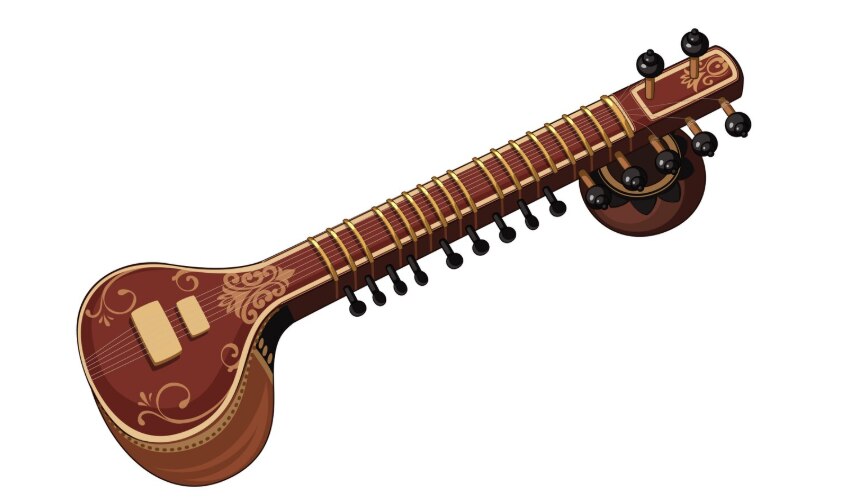
Before enrolment, confirm whether you need to own a Saraswati veena. This is the standard instrument for Carnatic veena classes for beginners: roughly four feet long, with 24 frets, four main strings, and three smaller drone or rhythm strings. Ask whether the school lends one, arranges a rental, or expects you to bring your own.
- Choose a comfortable sruti, or tonic, with the teacher; do not copy another learner’s pitch. Ask how tuning will be taught and whether an online lesson includes a tuner check.
- Prepare a stable floor seat: a firm cushion or low mat that lets you sit upright, with the veena supported securely across your lap and floor support. Keep enough room for the long neck; a cramped chair makes posture and fingering harder.
- Keep fingernails short and smooth, wear clothing that allows floor sitting, and reserve 15–20 minutes for practice. Shoulder, wrist, or back discomfort signals poor support, not a need to push through it.
- Bring a lined music notebook, pencil, phone or electronic tuner, and a soft cloth. Ask whether the teacher supplies a mizrab or expects right-hand plucking with fingernails, then obtain the correct accessory.
For an in-person lesson, check storage, parking, and public-transport access before buying an instrument. For online teaching, place the veena where the teacher can see both hands and the frets, and confirm the camera angle in advance. A trial should demonstrate posture, plucking, fingering, tuning, and simple swara work—not only a song.
What the first three months should teach you
By the end of three months, an adult beginner should sit comfortably with the Saraswati veena, keep a steady sruti, pluck cleanly, place the left-hand fingers accurately, and play short swara patterns without guessing.
A staged teacher will demonstrate phrases as well as write notation, because notation records swara sequences but cannot fully show a gamaka’s direction, speed, amplitude, or timing.
Expect these technical foundations:
- Posture, instrument support, hand placement, and relaxed movement.
- Right-hand plucking with the main playing string and controlled alternation.
- Left-hand fingering across the 24 frets, including clean note changes.
- Tuning awareness and sruti alignment against a tambura or electronic drone.
- Sarali varisai, janta varisai, and alankaram in more than one speed.
- Listening-and-imitation exercises before copying phrases from notation.
| Stage | What you should practise | Evidence of progress |
|---|---|---|
| Month 1 | Open-string plucking, basic fingering, simple swaras, and steady tala | You can maintain posture and play a short pattern evenly |
| Month 2 | Sarali varisai, janta varisai, alankaram, speed changes, and sruti correction | You can repeat exercises with fewer pauses and cleaner notes |
| Month 3 | A simple geetham, or the opening of a beginner varnam, with phrase-based gamakas | You can play slowly from memory while keeping tala |
For online veena lessons in Bengaluru, position the camera to show both hands clearly. Because video delay disrupts simultaneous playing, expect separate demonstrations, response exercises, or submitted practice recordings.
How much to practise and which learning goal to choose
Set aside 20 minutes on five days each week rather than depending on one long weekend session. Use five minutes for posture, tuning, and right-hand plucking; ten for swara exercises and tala; five for revising the assigned passage. Short, repeatable practice builds control faster than irregular two-hour efforts.
Make the routine survive work disruptions:
- Keep the veena assembled in a safe, accessible place.
- Record one practice session and note the exercise, tempo, and difficulty.
- Ask for recorded make-up work or an occasional online lesson when travel or deadlines interrupt attendance.
- Increase to 30–40 minutes only when your hands remain relaxed and accurate.
The best goal determines what the teacher assigns in veena classes for beginners. Ask whether the progression is staged for adults rather than copied from a children’s timetable. Carnatic playing also requires gamaka—slides and controlled pitch oscillations—not merely pressing the correct frets.
| Goal | Course emphasis | Suitable outcome |
|---|---|---|
| Foundation | Posture, tuning, plucking, fingering, swaras, tala, and basic gamaka | Confident independent practice |
| Devotional | Simple kritis, lyrics, repetition, and steady accompaniment | Playing selected bhajans or kritis |
| Light music | Accessible melodies, simplified phrases, and rhythm | Playing familiar songs |
| Performance | Memorisation, expression, stage tempo, and complete pieces | Presenting a prepared recital |
| Examination | Prescribed syllabus, notation, theory, and timed preparation | Meeting a named examination standard |
For veena classes in Bengaluru for adults, state your goal during enquiry. A foundation course suits uncertain beginners; choose performance or examination training only when you can protect regular practice time.
Questions to ask during a trial or enquiry
A trial should test the school’s teaching method, not merely let you play along with a song. Ask questions that expose how the teacher builds technique, corrects errors, and fits lessons around adult responsibilities.
- Do you teach Saraswati veena posture, hand placement, tuning, plucking, and fingering in stages?
- How will you teach tala: hand counts, a metronome, or another pulse method?
- What practice routine do you expect each week, and what happens if work disrupts it?
- How do you demonstrate gamakas and phrases that notation cannot fully show?
- Will I receive corrections through marked notes, audio or video feedback, or a review at the next lesson?
- What should I be able to play after one, three, and six months?
- Do you use a progression of exercises, revision, and repertoire rather than teaching songs only?
- Can you slow the sequence for an adult beginner, and are recorded make-up lessons or occasional online sessions available?
- Which language will you use for explanations, and how will online and in-person lessons follow the same curriculum?
- What veena, seating arrangement, tuning support, and notebook do I need before starting?
Search results for veena classes near me and veena lessons in bengaluru are only a starting point; ask to see a sample lesson plan and a beginner progress record. If you contact Sri Veena Vani Music School, use these questions to verify how its online or in-person option would fit your schedule and learning pace.
Related product
Veena Classes ₹3000 Sri Veena Vani Music School in Bengaluru, India, offers professional and structured veena classes for learners of all ages. View product → |
Frequently asked questions
How do I choose convenient veena classes in Bengaluru?
Measure the complete journey at lesson time, including door-to-classroom travel, traffic, parking or bus access, and carrying a full-size Saraswati veena.
What do I need before my first veena lesson?
Confirm whether the teacher provides an instrument or expects you to bring a veena, then ask what notebook, seating arrangement, and lesson materials to prepare.
What should the first three months of veena lessons teach?
Ask for a clear progression covering posture, instrument handling, plucking technique, basic fingering, rhythm, and simple pieces.
How much should an adult beginner practise veena?
Choose a weekly practice target you can maintain, then match your class schedule and learning goal to that available time.
What should I ask during a veena class trial or enquiry?
Ask about lesson length, class size, beginner progression, practice expectations, instrument access, make-up lessons, and how the teacher tracks progress.
Keywords